Cybersecurity Fundamentals
Chapter Overview
Welcome to the foundational chapter of your CCNP CCIE Security journey! In the rapidly evolving landscape of enterprise IT, understanding the bedrock principles of cybersecurity isn’t just theoretical knowledge — it’s the strategic advantage that keeps organizations operational and secure. This chapter lays the essential groundwork by defining key terminology and exploring the core challenges that security professionals face daily. Think of it as building a strong mental model for understanding attacks, defenses, and the critical data we aim to protect.
In a real-world enterprise, a solid grasp of these fundamentals translates directly into effective decision-making. When a new vulnerability is announced, knowing whether it’s a software bug or a misconfiguration helps you prioritize remediation. When an incident occurs, distinguishing between an availability issue and a confidentiality breach guides the response team. Every security tool, policy, and architecture you will learn later in this course is built upon the concepts introduced here.
We’ll move beyond simple definitions to explore how these concepts intertwine, creating a complex web of risks and countermeasures. You’ll gain insight into why a “defense-in-depth” strategy is crucial, how intelligence sharing strengthens collective security, and why the human element remains both the strongest and weakest link in the security chain.
Core Concepts
Understanding Threats, Vulnerabilities, and Exploits
At the heart of cybersecurity are the distinct but interconnected concepts of threats, vulnerabilities, and exploits. A threat represents any potential danger that could exploit a vulnerability to breach security or cause harm to an asset. A vulnerability is a weakness in a system, design, implementation, or configuration that could be taken advantage of. An exploit is the specific piece of code, technique, or method used by a threat actor to leverage a vulnerability, leading to unauthorized access, data loss, or system disruption.
💡 Real-world Example: Imagine a web server running outdated software (a vulnerability) that has a known flaw allowing remote code execution. A malicious actor (the threat) could then use a pre-written script (the exploit) specifically designed to leverage that flaw, taking control of the server and compromising its data.
The CIA Triad: Confidentiality, Integrity, and Availability
The CIA Triad forms the cornerstone of information security, guiding the objectives of any robust security program.
- Confidentiality — ensures that sensitive information is accessible only to authorized individuals, preventing unauthorized disclosure.
- Integrity — guarantees that data remains accurate, consistent, and unaltered throughout its lifecycle, protecting against unauthorized modification or destruction.
- Availability — ensures that systems and data are accessible and usable by authorized users when needed, preventing denial of service.
💡 Real-world Example: When a bank uses encryption for customer financial records, it’s preserving confidentiality. If a transaction log is digitally signed to prevent tampering, that’s ensuring integrity. When the bank’s online portal is designed with redundancy and DDoS protection to remain accessible 24/7, that’s maintaining availability.
Common Software Vulnerabilities
Software vulnerabilities are ubiquitous and often stem from coding errors or insecure development practices:
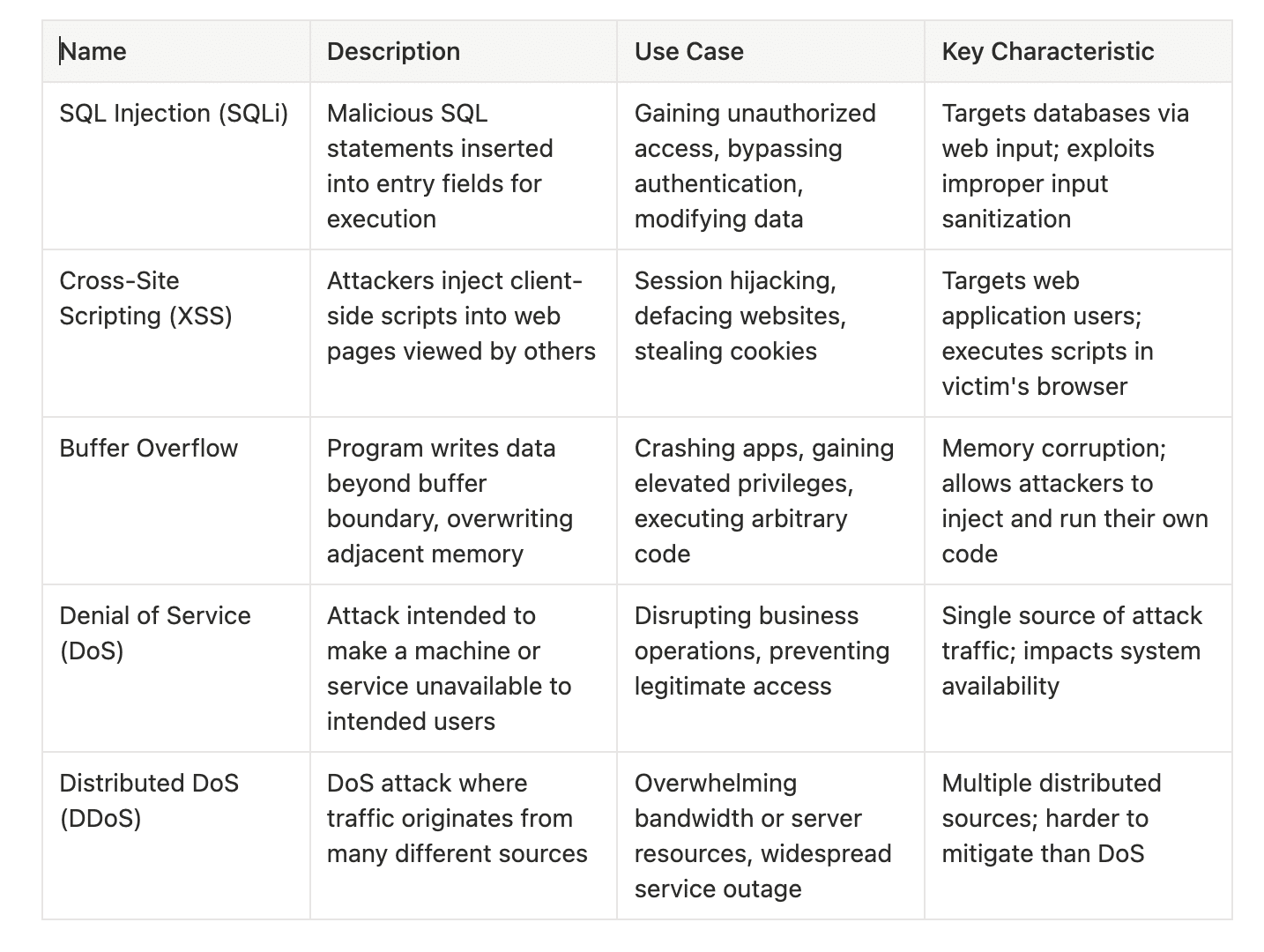
- SQL Injection — malicious SQL code is inserted into input fields to manipulate database queries.
- Cross-Site Scripting (XSS) — attackers inject client-side scripts into web pages viewed by other users.
- Buffer Overflow — a program writes data beyond the allocated buffer, potentially overwriting adjacent memory and enabling arbitrary code execution.
💡 Real-world Example: A login form that doesn’t properly sanitize user input could be vulnerable to SQL injection. An attacker might enter
' OR '1'='1into the username field, causing the database to authenticate them without knowing the correct password.
Cloud Security Threats
While cloud computing offers immense benefits, it introduces distinct security challenges:
- Data Breaches — often due to misconfigurations of cloud storage or access controls.
- Insecure APIs — can expose sensitive data or allow unauthorized actions if not properly secured and authenticated.
- Compromised Credentials — cloud management console credentials can grant attackers broad access to an organization’s entire cloud infrastructure.
💡 Real-world Example: An administrator accidentally leaves an Amazon S3 storage bucket configured for public read access. This misconfiguration leads to a data breach, exposing sensitive customer information.
Security Intelligence: Authoring, Sharing, and Consumption
Security intelligence is vital for proactive defense:
- Authoring — generating intelligence internally from incident response or vulnerability assessments.
- Sharing — exchanging intelligence with trusted partners, industry groups, or government entities.
- Consumption — integrating external intelligence feeds into security tools and workflows to enhance detection and prevention.
💡 Real-world Example: A SOC detects a new malware variant (authoring), shares Indicators of Compromise like file hashes and C2 IPs with an industry group (sharing), and other organizations integrate those IOCs into their firewalls and SIEM platforms (consumption).
The Role of the Endpoint in Protecting Against Phishing and Social Engineering
The endpoint is often the last line of defense against attacks targeting humans directly.
- Phishing — tricks users into revealing credentials or installing malware via deceptive emails.
- Social Engineering — psychological manipulation to induce people to divulge confidential information or perform unsafe actions.
Endpoint protection platforms (EPP), email security gateways, and EDR solutions are crucial for detecting malicious attachments, blocking phishing sites, and identifying suspicious activity.
💡 Real-world Example: A user receives a convincing email appearing to be from their CEO, requesting an urgent wire transfer. An email gateway quarantines it. Even if it reaches the inbox, an endpoint agent blocks the malicious link or prevents execution of a downloaded malware attachment.
Real World Analogy
🏠 Imagine your house as an organizational asset. A vulnerability might be leaving a window unlocked. A burglar lurking nearby represents a threat. The lock-picking kit they use is the exploit. If they succeed, your privacy is breached (loss of confidentiality), valuables are stolen (loss of integrity), and you can’t feel safe (loss of availability). Understanding these distinctions helps you focus defenses: stronger locks (mitigate vulnerability), a guard dog (deter threat), an alarm system (detect exploit).
Chapter Recap
This chapter established the foundational lexicon of cybersecurity, differentiating between threats, vulnerabilities, and the exploits used to weaponize them. We explored the critical CIA Triad as the core objectives all security measures aim to uphold. We examined prevalent software vulnerabilities like SQL injection and XSS, and extended the discussion to unique cloud security challenges around insecure APIs and compromised credentials.
We also introduced proactive defense mechanisms — the lifecycle of security intelligence from authoring and sharing to consumption — and underscored the irreplaceable role of endpoint protection in safeguarding against phishing and social engineering. These fundamentals form the bedrock upon which all advanced security strategies are built.
Key Exam Points
- Distinguish accurately between a threat (potential danger), a vulnerability (weakness), and an exploit (method to leverage weakness).
- Identify which part of the CIA Triad is impacted by specific attacks — DoS impacts Availability, data breach impacts Confidentiality.
- Recall common software vulnerabilities: SQL injection, XSS, buffer overflow, path traversal, and hardcoded passwords.
- Understand cloud-specific threats per SCOR 350-701: data breaches, insecure APIs, DoS/DDoS, and compromised credentials.
- Explain the process and benefits of security intelligence authoring, sharing, and consumption.
- Describe the critical role of endpoint security in protecting users from phishing and social engineering.
- Recognize that encryption and access controls are primary mechanisms for preserving confidentiality.
- Understand that DoS/DDoS attacks specifically target and reduce system or service availability.
- Differentiate the broader scope of cybersecurity (risk management, threat intelligence, incident response) from traditional information security.
Common Mistakes to Avoid
⚠️ Confusing a threat with a vulnerability — A threat is the potential for harm (e.g., a hacker group), while a vulnerability is a weakness (e.g., unpatched software). A threat actor exploits a vulnerability.
⚠️ Believing Availability simply means a system is “up” — Availability means authorized users can access resources when and where needed. A system can be “up” but unavailable due to network congestion or misconfigured access controls.
⚠️ Assuming cloud providers handle all security — The shared responsibility model means the provider secures the cloud infrastructure, but you are responsible for security in the cloud — data, applications, and network configurations.
⚠️ Underestimating social engineering — Many successful breaches begin with phishing, targeting human weakness that bypasses advanced technical controls. Endpoint protection and user awareness are paramount.
⚠️ Viewing security intelligence as just a list of bad IPs — Security intelligence is context-rich, actionable information about adversaries, their TTPs, and IOCs, used for proactive defense — not just reactive blocking.