Securing the Cloud
Chapter Overview
The rapid adoption of cloud computing has fundamentally reshaped enterprise IT, offering unparalleled agility, scalability, and cost efficiency. However, this shift introduces a complex array of new security challenges. Traditional perimeter-based defences are often inadequate in dynamic, distributed cloud environments — requiring a deep understanding of how security responsibilities are shared, how applications are developed securely, and what specialised tools protect cloud assets.
Securing the cloud is not merely an extension of on-premises security. It is a distinct discipline requiring a nuanced approach — from understanding where your responsibilities begin and end, to integrating security into every stage of the development lifecycle, to deploying cloud-native security tools.
Core Concepts
Cloud Service and Deployment Models
Cloud computing fundamentally changes how resources are consumed and managed. The three primary service models represent different levels of abstraction and control:
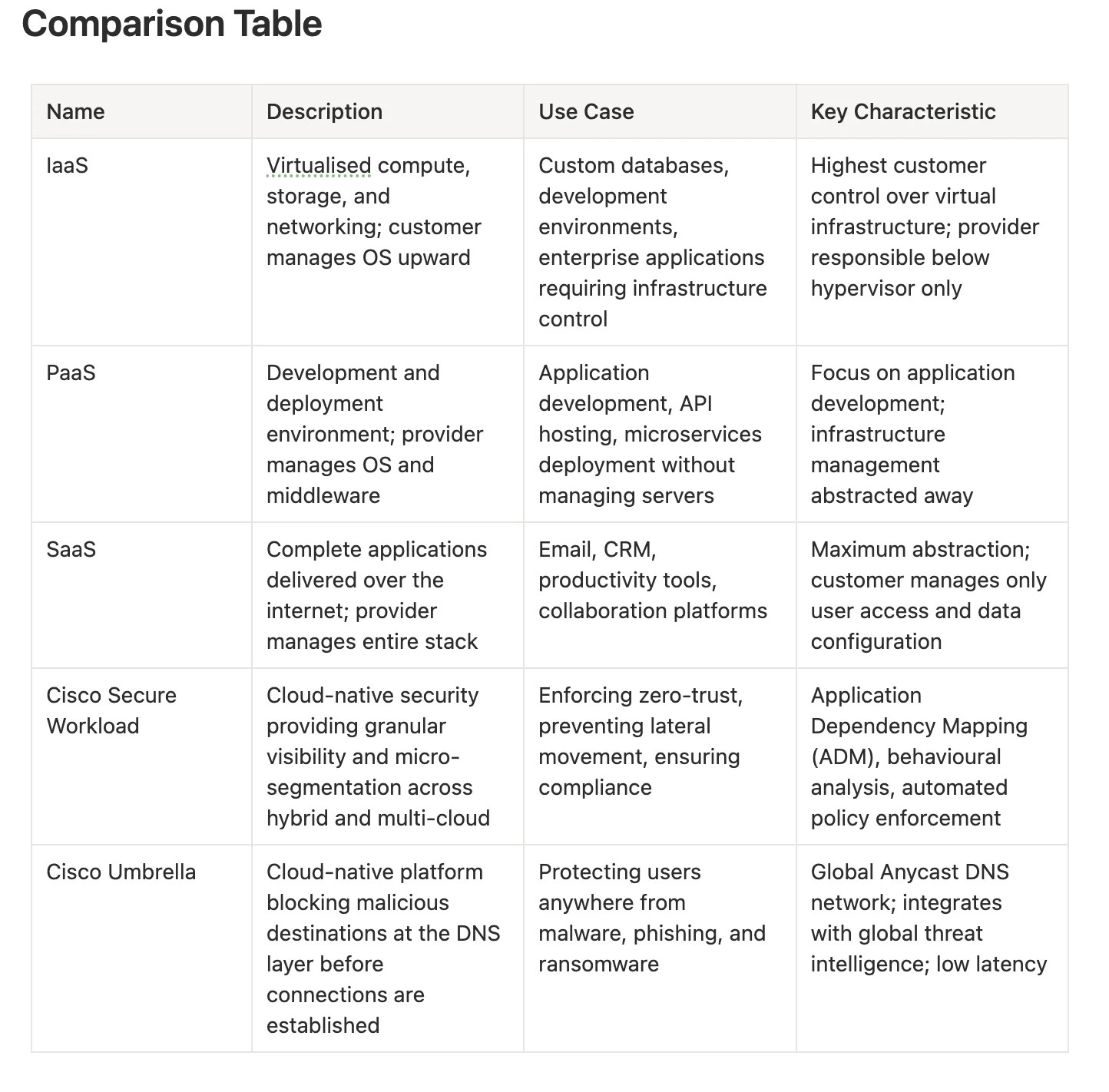
- IaaS (Infrastructure as a Service) — virtualised compute, storage, and networking. Customer manages OS, applications, and data.
- PaaS (Platform as a Service) — complete development and deployment environment. Provider manages OS and middleware; customer manages applications and data.
- SaaS (Software as a Service) — complete ready-to-use applications. Provider manages the entire stack; customer manages user access and data.
Deployment models — Public, Private, Community, and Hybrid — describe where and by whom these services are hosted.
💡 Real-world Example: A startup choosing IaaS rents virtual machines from AWS and installs their own OS, web server, and application code. With PaaS (Google App Engine), they focus solely on writing application code. With SaaS (Salesforce), they simply subscribe and use the CRM — managing no infrastructure at all.
The Shared Responsibility Model
The Shared Responsibility Model clarifies the division of security duties between the cloud provider and the customer. The exact boundary shifts based on the service model: the provider is responsible for “security of the cloud” (physical infrastructure, hypervisor), while the customer is responsible for “security in the cloud” (OS, applications, data, access controls).
💡 Real-world Example: In an Azure IaaS deployment, Microsoft secures the physical data centres, network infrastructure, and hypervisor. The customer is responsible for patching the OS running on the VM, configuring network access controls, installing anti-malware, and protecting data within the VM. A breach due to an unpatched OS is the customer’s responsibility — not a provider failure.
DevSecOps Integration
DevSecOps integrates security throughout the entire software development lifecycle (SDLC) — from design through development, testing, deployment, and operation. It embeds security into CI/CD pipelines, making it an inherent part of agile development rather than a post-development afterthought. This reduces risk and accelerates secure deployments.
💡 Real-world Example: A development team incorporates automated SAST (static application security testing) into their CI pipeline to scan for vulnerabilities on every code commit. Before production deployment, DAST runs against staging and IaC templates are scanned for misconfigurations — ensuring security checks are continuous, not just a final gate.
Cloud Logging and Monitoring
Comprehensive logging and monitoring provide the visibility essential for detecting anomalies and responding to incidents in cloud environments. This involves collecting logs from cloud services (API activity, network flow logs, application logs), aggregating them centrally, and analysing them for suspicious patterns or indicators of compromise.
💡 Real-world Example: An organisation configures AWS CloudTrail to log all API calls and combines these with VPC Flow Logs for network visibility, integrating both into a centralised SIEM. Automated rules trigger an alert if a user attempts multiple failed logins to an admin console, or if an EC2 instance suddenly communicates with a known malicious IP.
Application and Workload Security
Securing cloud applications and workloads requires protecting runtime environments, API endpoints, and data — not just the network perimeter. This includes micro-segmentation to isolate individual workloads, vulnerability management for containers and applications, and API security to protect cloud service interfaces.
💡 Real-world Example: Using Cisco Secure Workload, an enterprise deploys agents to cloud VMs and containers. The agents map application communication patterns and automatically enforce micro-segmentation policies — a web server can only reach its designated application server on specific ports, and the application server can only reach its database. If one component is compromised, lateral movement is blocked.
Real World Analogy
🏨 Think of cloud service models like different types of accommodation. Buying a house (on-premises) — you own and maintain everything. Renting an apartment (IaaS) — the landlord maintains the building, but you manage your furniture, cleaning, and locks. A serviced hotel apartment (PaaS) — the hotel provides furnishings and cleaning; you manage your personal belongings. An all-inclusive resort (SaaS) — almost everything is handled; you are only responsible for your own actions and valuables. The further up the service model you go, the less you control — but you always retain responsibility for your own data and how you use the services.
Chapter Recap
This chapter illuminated the critical landscape of cloud security — starting with the foundational service models (IaaS, PaaS, SaaS) and their deployment counterparts. The Shared Responsibility Model is a central theme: security responsibilities shift with the service model, and misinterpreting this boundary is a leading cause of cloud vulnerabilities.
DevSecOps integrates security into CI/CD pipelines, shifting from reactive to proactive threat mitigation. Robust logging and monitoring provide the visibility required for timely incident detection. Cisco Secure Workload and Cisco Umbrella provide cloud-native security for workloads and DNS-layer threat prevention respectively. Together, these concepts form the foundation for securing modern hybrid and multi-cloud enterprise architectures.
Key Exam Points
- NIST SP 800-145 defines cloud computing’s five essential characteristics and three service/deployment models.
- IaaS: customer manages OS, applications, data, network config; provider manages physical infrastructure and virtualisation.
- PaaS: customer manages applications and data; provider manages OS, runtime, middleware, infrastructure.
- SaaS: customer manages data and user access only; provider manages the entire application stack.
- DevSecOps integrates security into the entire SDLC, emphasising automation and continuous security checks within CI/CD pipelines.
- Cisco Umbrella provides DNS-layer security using a global Anycast network for resilient, scalable threat protection.
- Cisco Secure Email Threat Defense Forged Email Detection (FED) analyses SMTP headers to identify spear phishing and domain impersonation.
- Cisco Secure Workload delivers Application Dependency Mapping (ADM) and micro-segmentation for zero-trust security.
- Cloud logging is critical: collect audit logs (CloudTrail, Azure Activity Logs), flow logs, and application logs for centralised analysis.
- Cisco XDR consolidates telemetry across network, endpoint, cloud, and email to prioritise incidents based on risk.
Common Mistakes to Avoid
⚠️ The cloud provider does not handle all security — The Shared Responsibility Model explicitly defines customer duties for “security in the cloud,” which can be extensive depending on the service model.
⚠️ Cloud security is not just a perimeter problem — Cloud environments require security integrated into development (DevSecOps), applied at workload level, and continuously monitored — not just a perimeter firewall.
⚠️ Don’t neglect logging and monitoring — Without visibility into cloud API calls, flow logs, and application events, threat detection and incident response are nearly impossible. Centralised log aggregation is essential.
⚠️ Weak IAM is a leading cause of cloud breaches — Overly permissive roles, unprotected API keys, and missing MFA are primary attack vectors. Least privilege and regular access reviews are non-negotiable.
⚠️ Containers and serverless functions have unique attack surfaces — They require specialised security tools beyond securing the underlying VMs or infrastructure. Don’t assume traditional security controls cover cloud-native workloads.