
Network Visibility and Segmentation
Chapter Overview
In the complex landscape of modern enterprise networks, two concepts stand paramount for robust cybersecurity: comprehensive visibility and intelligent segmentation. Without a clear understanding of what is happening across your network — who is communicating with whom, what applications are being used, and where data is flowing — it is virtually impossible to detect and respond to threats effectively.
Once you can see the network, the next critical step is to control it. Network segmentation moves beyond simple perimeter defenses, logically dividing your network into smaller isolated zones. This limits the blast radius of a potential breach, prevents lateral movement of attackers, and enforces granular access policies based on the principle of least privilege — transforming a flat, easily traversable network into a fortified series of compartments.
Core Concepts
NetFlow and IPFIX
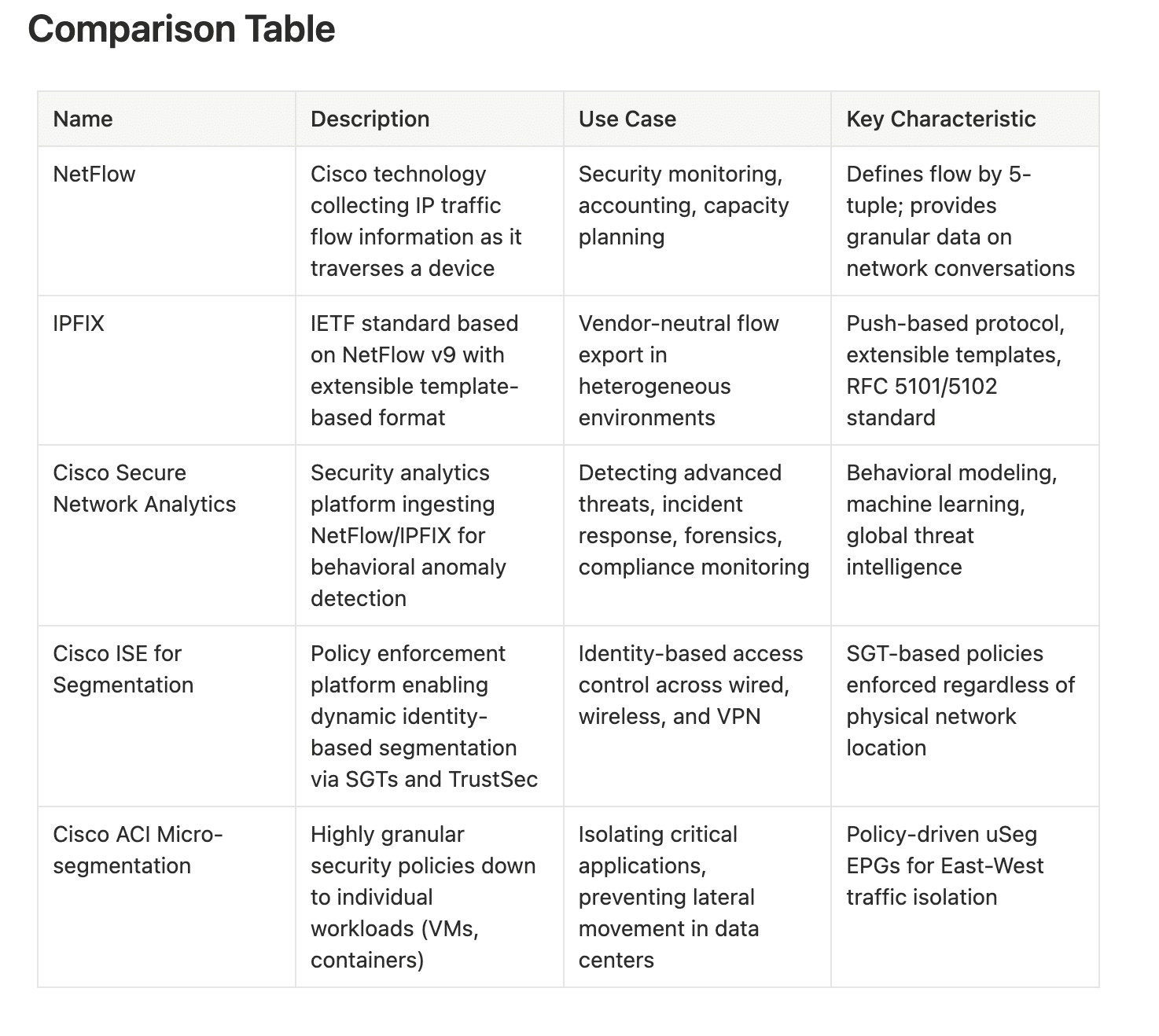
NetFlow is a Cisco-developed technology for collecting IP traffic flow information as it traverses a device. A flow is typically defined by a 5-tuple: source IP, destination IP, source port, destination port, and IP protocol. IPFIX (RFC 5101/5102) is the IETF standard based on NetFlow v9, offering extensibility and a push-based data export model.
💡 Real-world Example: A sudden spike in outbound traffic from an internal server that typically has low external communication. By analyzing NetFlow records, you quickly identify the specific destination IPs, ports, and protocols involved — potentially uncovering a data exfiltration attempt or a compromised host beaconing to a command-and-control server.
Cisco Secure Network Analytics (formerly Stealthwatch)
Cisco Secure Network Analytics is a comprehensive network visibility and security analytics solution that ingests NetFlow and IPFIX data from across the network. It uses behavioral modeling, machine learning, and global threat intelligence to detect advanced threats — including malware, insider threats, and zero-day attacks — that bypass traditional signature-based security tools.
💡 Real-world Example: A user’s workstation suddenly communicates with an internal server using a port associated with peer-to-peer file sharing. Secure Network Analytics detects this unusual behavior, correlates it with other network events, and flags it as a potential policy violation or malware attempting lateral movement — even without an explicit signature for the traffic.
Network Segmentation
Network segmentation divides a network into smaller, isolated zones to limit the spread of threats and enforce access policies. Strategies range from traditional VLANs to advanced identity-based and application-aware segmentation using ISE and ACI.
💡 Real-world Example: A hospital segments patient care systems (EHR) from administrative systems, visitor Wi-Fi, and research labs. If the guest Wi-Fi is compromised, segmentation prevents attackers from accessing critical patient data or disrupting medical devices — significantly reducing the attack surface.
Cisco ISE for Segmentation
Cisco ISE provides a centralized policy enforcement platform enabling identity-based network access and dynamic segmentation through TrustSec. It assigns Security Group Tags (SGTs) to users and devices based on identity, role, and context — enforcing access policies at various points in the network regardless of physical location.
💡 Real-world Example: A contractor connects to the corporate network. Cisco ISE identifies them, assigns an SGT for contractors, and enforces access to only permitted resources (specific file shares and internet access) — preventing any communication with sensitive internal servers, regardless of which VLAN they are on.
Cisco ACI Micro-segmentation
Cisco ACI delivers policy-driven automation and centralized management for data center networks. Endpoint Groups (EPGs) define collections of endpoints sharing common policy requirements. Micro-segmentation (uSeg EPGs) applies policies down to individual VMs or containers within an EPG — isolating them even on the same subnet, dramatically reducing East-West attack vectors.
💡 Real-world Example: In a multi-tier application, the web server, application server, and database server each belong to different uSeg EPGs. Even on the same VLAN, ACI policies ensure only the web server can reach the app server on specific ports, and only the app server can reach the database — preventing direct web-to-database access if the app server is compromised.
Real World Analogy
🏙️ Think of a secure smart city. Network visibility is like the city’s CCTV and traffic monitoring system — giving authorities a real-time view of everything happening across the city, enabling rapid detection of suspicious activity. Network segmentation is the city’s organization into distinct districts — a financial district, residential area, industrial park, and secure government complex — each with its own access rules and boundaries. Within the government complex, specific buildings (micro-segments via ACI or ISE) have even stricter identity-based access controls. Even if an incident occurs in one district, its impact is contained and cannot spread to the rest of the city.
Chapter Recap
This chapter established that network visibility and segmentation are two sides of the same security coin. NetFlow and IPFIX provide the raw data for visibility, while Cisco Secure Network Analytics transforms that data into actionable threat intelligence using behavioral modeling and machine learning.
On the segmentation side, we moved from traditional VLANs to sophisticated identity-based approaches. Cisco ISE enables dynamic SGT-based segmentation that follows users regardless of physical location, while Cisco ACI micro-segmentation isolates individual workloads in the data center — together dramatically reducing lateral movement opportunities for attackers.
Key Exam Points
- A flow is defined by a 5-tuple: source IP, destination IP, source port, destination port, and IP protocol.
- IPFIX (RFC 5101/5102) is the IETF standard based on NetFlow v9, offering extensibility and push-based export.
- Cisco Secure Network Analytics (formerly Stealthwatch) uses behavioral modeling, machine learning, and threat intelligence for anomaly detection.
- NetFlow deployment best practice: enable as close to the access layer as possible; send all flow records for a given flow to the same collector.
- Flexible NetFlow components: records, flow monitors, flow exporters, and flow samplers.
- Cisco ISE uses Security Group Tags (SGTs) for TrustSec-based dynamic segmentation — policies follow identity, not location.
- Cisco ACI implements micro-segmentation using EPGs; uSeg EPGs provide individual workload isolation.
- Traditional VLANs provide network isolation but lack the dynamic, identity-based granularity of ISE or ACI segmentation.
Common Mistakes to Avoid
⚠️ VLANs alone are not effective segmentation — While VLANs provide network isolation, advanced segmentation with ISE or ACI offers dynamic, identity-based, application-aware policy enforcement far more resilient against modern threats.
⚠️ Don’t deploy NetFlow collectors centrally without planning — For optimal performance and data integrity, collectors should be distributed closer to high-volume source devices, especially in large or multi-site deployments.
⚠️ Visibility without analytics is insufficient — Raw NetFlow data alone doesn’t detect threats. A behavioral analytics platform like Secure Network Analytics is needed to correlate flows and identify anomalies.
⚠️ Micro-segmentation requires ongoing policy maintenance — Policies must be reviewed and updated as applications evolve. Stale or overly permissive policies defeat the purpose of micro-segmentation.