Software-Defined Networking Security and Network Programmability
Chapter Overview
In today’s rapidly evolving IT landscape, traditional device-centric network management struggles to keep pace with the demands of cloud-native applications, virtualization, and distributed workforces. This chapter dives into Software-Defined Networking (SDN) and Network Programmability — two transformative paradigms reshaping how we design, deploy, and secure network infrastructures.
For enterprise security professionals, understanding SDN and network programmability is about building a fundamentally more secure network. The ability to define and enforce security policies centrally, automate configuration changes, and gain a global view of network traffic empowers organizations to implement granular access controls, rapidly respond to threats, and ensure consistent policy enforcement across diverse environments.
We will examine Cisco’s Application Centric Infrastructure (ACI) as a leading SDN solution, detail its architecture and how it leverages VXLAN for scalable network segmentation, and explore network programmability through API types like REST, SOAP, NETCONF, and RESTCONF.
Core Concepts
Traditional Networking Planes
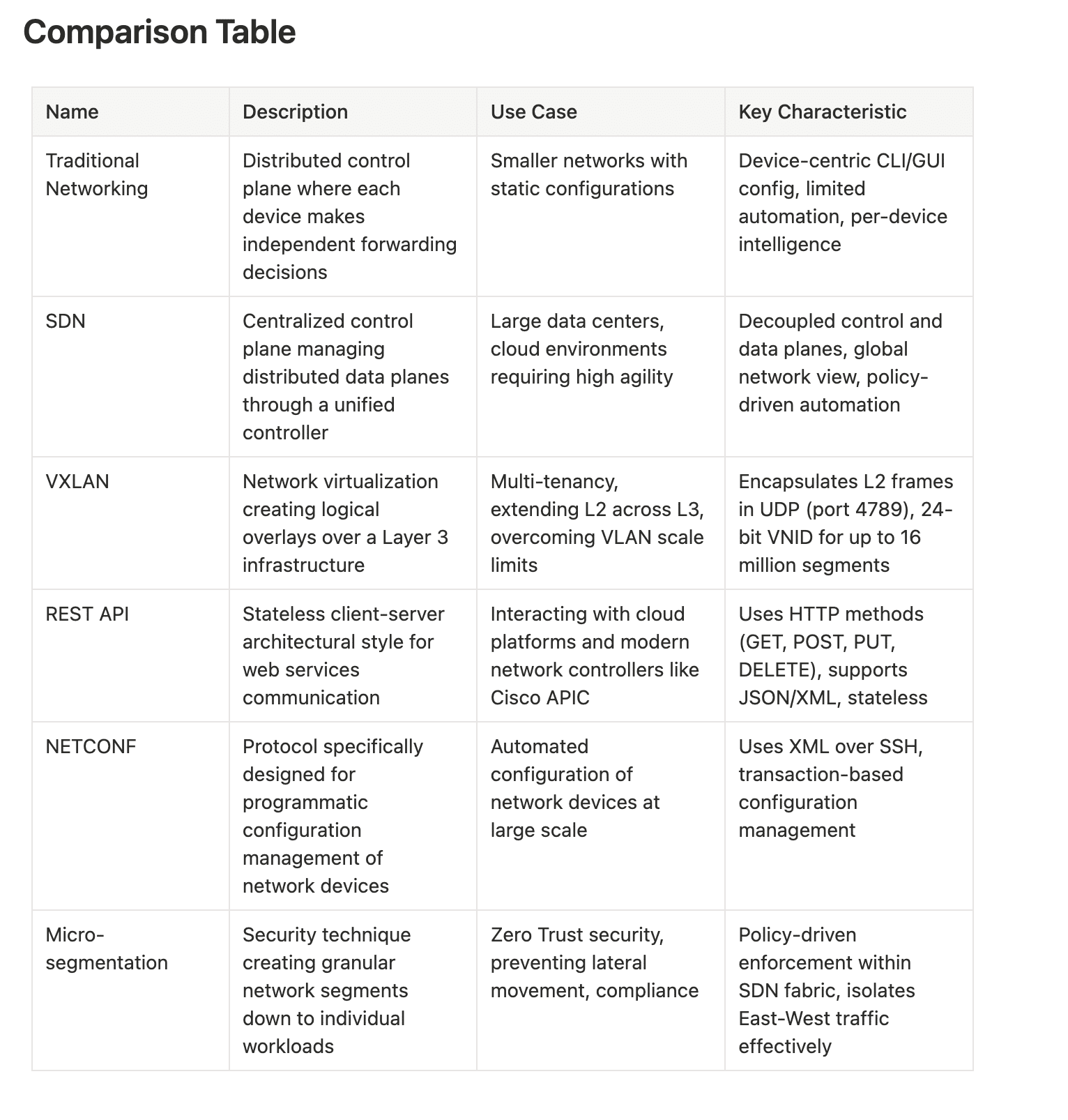
Traditional network devices operate across three distinct planes:
- Management plane — for device configuration and monitoring.
- Control plane — for making forwarding decisions like routing protocols.
- Data plane — for physically forwarding packets.
Each device operates these planes independently, making decentralized decisions and requiring individual configuration — leading to operational complexity and potential policy inconsistencies across large networks.
💡 Real-world Example: In a large campus network, to configure a new VLAN or update a routing policy, an administrator would log into each device individually via CLI, apply changes, and verify them — a time-consuming, error-prone process.
Software-Defined Networking (SDN)
SDN revolutionizes networking by decoupling the control plane from the data plane. A centralized SDN controller takes on the role of the control plane, possessing a global view of the network and programming underlying data plane devices with forwarding rules — enabling centralized policy enforcement, automation, and greater network agility.
💡 Real-world Example: In a modern data center using SDN, when a new virtual machine is provisioned, the SDN controller automatically configures the necessary network segments, applies security policies, and optimizes traffic paths — without manual intervention on individual switches.
Cisco Application Centric Infrastructure (ACI)
Cisco ACI is a prominent SDN solution designed for data centers, focusing on application-driven policy enforcement. Its architecture uses a leaf-and-spine topology managed by the Application Policy Infrastructure Controller (APIC), which acts as the central brain. ACI abstracts network complexity, allowing administrators to define application requirements and security policies that the APIC translates into network configurations across the fabric.
💡 Real-world Example: A financial institution deploying a new trading application uses ACI to define security groups for web, application, and database servers. The APIC automatically creates network segments and enforces micro-segmentation policies — web servers can talk to app servers on port 8080 but not directly to databases — without configuring ACLs on dozens of individual devices.
VXLAN and Network Overlays
Virtual Extensible LAN (VXLAN) is a network virtualization technology that creates logical network overlays on top of an existing physical IP network. It encapsulates Layer 2 Ethernet frames within UDP packets (port 4789), using a VXLAN Network Identifier (VNID) for segmentation. This overcomes VLAN limitations in large, scalable data centers.
💡 Real-world Example: A multi-tenant cloud provider uses VXLAN to isolate customer networks. Each customer gets their own VXLAN segment, even if their VMs run on the same physical server. The encapsulation ensures traffic from one customer cannot leak into another’s segment.
Network Programmability and APIs
Network programmability refers to configuring, managing, and monitoring network devices using programmatic interfaces (APIs). APIs like REST, SOAP, NETCONF, and RESTCONF allow engineers to interact with devices and controllers using code, enabling automation, orchestration, and integration with other IT systems.
💡 Real-world Example: A security operations team automates firewall rule updates from threat intelligence feeds. A Python script uses a REST API to pull blacklisted IPs from a security vendor, then uses RESTCONF to push new rules directly to firewalls — all without human intervention.
Micro-segmentation
Micro-segmentation creates granular, isolated network segments down to the workload level (individual VMs or containers). Unlike traditional broad network zones, micro-segmentation restricts communication between workloads to only what is absolutely necessary, significantly reducing lateral movement of threats.
💡 Real-world Example: In an application with a web server, application server, and database server, micro-segmentation ensures the web server can only communicate with the app server on specific ports, and the app server only with the database on its specific port. If the web server is compromised, the attacker cannot move laterally to the database without bypassing these enforced policies.
Real World Analogy
🍳 Imagine a traditional kitchen where every appliance has its own control panel and you adjust each one individually. Now imagine a smart kitchen with a central control tablet — you say “prepare dinner” and it automatically preheats the oven, turns on the lights, and starts the coffee maker. The tablet is like the SDN controller (Cisco APIC), understanding your overall policy and orchestrating all appliances (network devices) to achieve that goal, simplifying management and ensuring everything works together according to your desired outcome.
Chapter Recap
This chapter explored the pivotal shift from traditional distributed network management to the centralized, policy-driven approach of SDN and network programmability. SDN decouples the control plane from the data plane, enabling a global network view and automated configuration through controllers like Cisco APIC within an ACI fabric. VXLAN provides scalable network overlays, forming the backbone of modern agile data centers.
Crucially, micro-segmentation dramatically reduces attack surfaces by enforcing granular workload-level security policies, particularly for East-West traffic. Network programmability through REST, SOAP, NETCONF, and RESTCONF enables rapid threat response and consistent policy deployment — indispensable for securing complex modern infrastructures.
Key Exam Points
- The three traditional networking planes are Management, Control, and Data.
- SDN’s core concept is the decoupling of the control plane from the data plane.
- Cisco APIC is the centralized controller in a Cisco ACI deployment, managing policy and topology.
- ACI uses a leaf-spine topology where leaf switches function as VXLAN Tunnel Endpoints (VTEPs) and enforce policies.
- VXLAN uses UDP port 4789 for encapsulation and a 24-bit VNID for segmentation (up to 16 million segments).
- East-West traffic = intra-data center (server to server). North-South traffic = client to server. Both have distinct security implications.
- Micro-segmentation is a key security benefit of SDN, enabling granular policy enforcement at the workload level.
- REST APIs are stateless, use standard HTTP methods, and support JSON/XML.
- NETCONF and RESTCONF are protocols specifically designed for programmatic network device configuration.
- A compromised SDN controller is a critical single point of failure — securing the APIC is paramount.
Common Mistakes to Avoid
⚠️ SDN still needs physical hardware — SDN abstracts the control and management planes but still relies on physical or virtual data plane forwarding hardware like switches and routers.
⚠️ VXLAN doesn’t replace VLANs everywhere — VXLAN addresses scalability limitations in large data centers and cloud environments, but VLANs remain fundamental for many traditional access layer designs.
⚠️ Network automation isn’t just Python and REST — Ansible, Puppet, Chef, NETCONF, and SOAP APIs are also widely used depending on the vendor and use case.
⚠️ Micro-segmentation ≠ traditional segmentation — Micro-segmentation enforces policies at workload-specific granularity within a single traditional network segment, restricting East-West traffic in ways traditional segmentation cannot.
⚠️ The SDN controller is a high-value target — Centralizing control offers security benefits but makes the controller a critical target for attackers. Securing the APIC is non-negotiable.