When designing network solution, often we are tasked to produce a Bill of Material, or BOM. Selecting the right transceiver type can be as complex as the actual router or switch model. There are various factors which influence these decisions and dictate your selection. Buy the wrong type of transceiver, and you would find yourself pulling your hair.
This tech post aims at simplifying the decision making and removing the guessing from the process.
Transceivers types
Transceivers or optics, have evolved and keep on evolving to meet both capacity and distance demands. For the sake of good housekeeping, optics are used when the media is fibre.
In this post, I will focus on Ethernet technology and standard. Here, we started using SFP for 1Gbps speed and as t today’s post, we are talking 800Gbps. So which optic type, covers what ? Before we get into this, and just to make things more interesting, the choice of optic, is also dependent on the fibre type – Single Mode Fibre (SMF), or Multi Mode Fibre (MMF).
As a rule of thumb, I would use SMF for long distances, since this is where I have less dispersion. Dispersion can be thought of as a waste, which limits the distance. MMF can be used in short distances, inter rack or even campus sites…but it also depends on the optic speed.
Below table shows the diversity of available optics, depending on speed and max distance.
| Type | Module | Speed | Wavelength 4 | Max Distance |
|---|---|---|---|---|
| SFP | GLC-LH | 1G | 1310 nm | 10 Km |
| SFP | GLC-EX | 1G | 1310 nm | 40 Km |
| SFP+ | SFP-10G-LR | 10G | 1310 nm | 10 Km |
| SFP+ | SFP-10G-ER | 10G | 1550 nm | 40Km |
| SFP28 | SFP-25G-LR | 25G | 1310 nm | 10 Km |
| QSFP28 | QSFP-100G-LR | 100G | 1310 nm | 10 Km |
| QSFP28 | QSFP-100G-ER-Lite | 100G | 40 Km | |
| QSFP-DD | QSFP-400G | 400G | 10 – 40 Km | |
| CQSFP-DD800 | QSFP-800G | 800G | 10 – 40 Km |
Choosing the right transceiver
Three factors would decide your selection. Hardware support, bandwidth requirements, and distance between nodes.
What optics are supported by your hardware:
You cannot expect any transceiver type to be supported by your equipment. Here, you must do your due diligence and investigate compatibility is not an issue. This is not limited to hardware only, but can also be software.
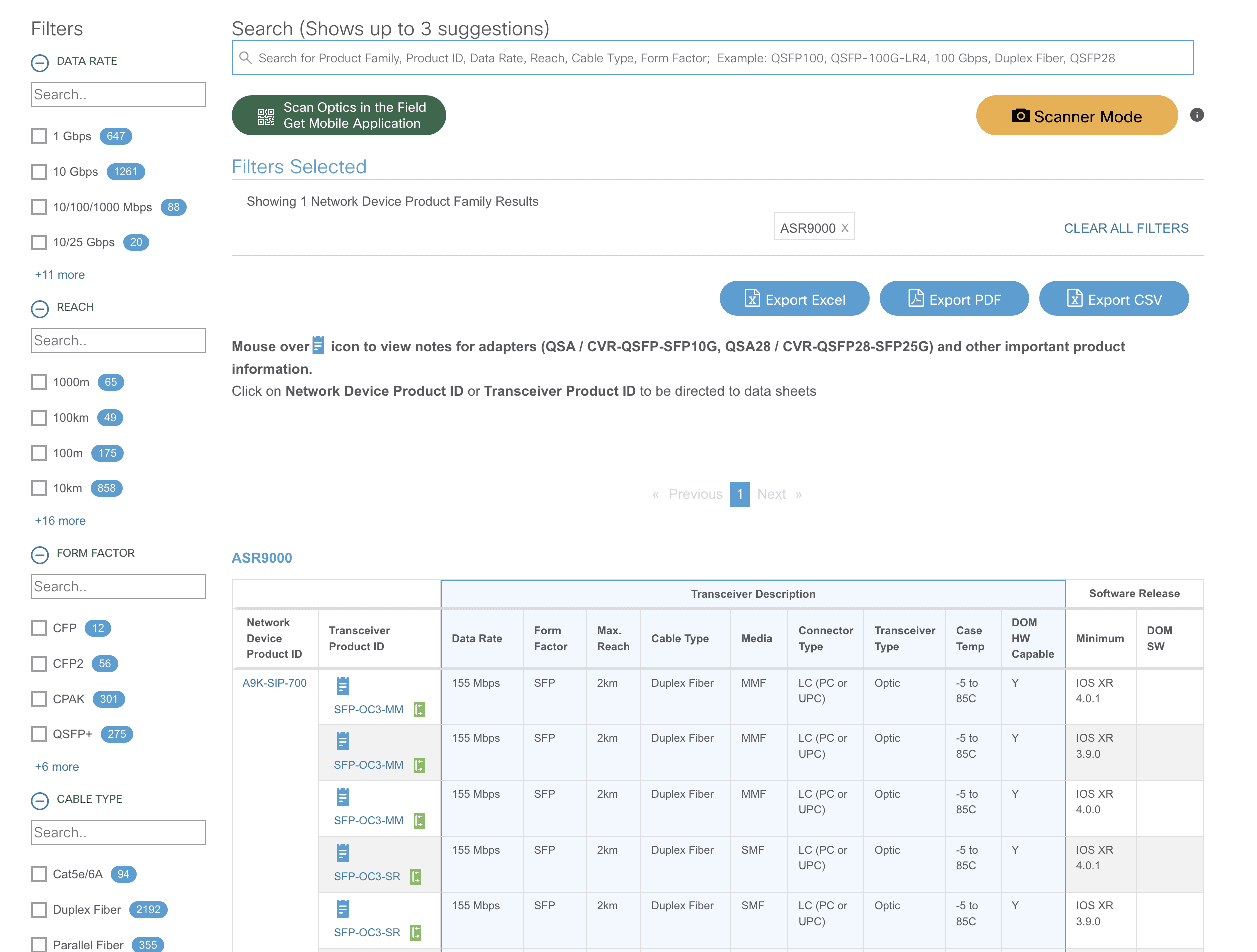
For Cisco, I rely on Cisco’s compatibility matrix. Here you start by searching your equipment model, then the different port speeds and S/W requirements.
In below example, I am looking at a Cisco ASR 9000
Bandwidth requirements:
This depends on your planning, trending and forecast for future growth.
Distance between nodes:
This requirement can often be challenging. If we are talking intra and inter campus sites, yo should be fine. However, if you are dealing with an ISP with POPs miles apart, you need to be on top of the distance requirements. 10Km is basic, for 40Km you need Extended Reach (ER) or even ZR for ultra extended reach.
For longer ranges, then you must consider DWDM or Coherent optics, this will be cover in another tech blog.