
Cryptography
Chapter Overview
In today’s interconnected digital landscape, cryptography provides the foundational tools and techniques to ensure data remains confidential, untampered, verifiable, and attributable to its sender. As security professionals, understanding cryptography is a critical skill that underpins virtually every secure communication, from browsing a website to establishing a VPN tunnel.
This chapter dives deep into the core cryptographic principles that power enterprise security solutions. We’ll explore various algorithms, their strengths, weaknesses, and appropriate applications — moving beyond simply knowing acronyms to truly understanding their operational mechanics. From the efficiency of symmetric ciphers used for bulk data encryption to the trust-building power of asymmetric algorithms and digital certificates, you’ll gain a holistic perspective on how these components interoperate to form robust security architectures.
For a CCNP/CCIE Security professional, a solid grasp of cryptography is non-negotiable. It informs your decisions when designing secure networks, configuring VPNs, implementing secure email, or deploying secure web services.
Core Concepts
Cryptographic Services
Cryptography provides fundamental security services crucial for protecting data in transit and at rest:
- Confidentiality — ensuring information is accessible only to authorized entities.
- Integrity — guaranteeing that data has not been altered.
- Authentication — verifying the identity of communicating parties.
- Non-repudiation — preventing a sender from denying they sent a message.
These pillars are achieved through a combination of encryption, hashing, and digital signatures.
💡 Real-world Example: When you send an encrypted email with S/MIME, the encryption ensures confidentiality, a digital signature provides integrity and authentication, and non-repudiation prevents the sender from later claiming they didn’t send that specific email.
Ciphers: Substitution and Transposition
A cipher is an algorithm used for performing encryption and decryption. Early ciphers relied on basic techniques:
- Substitution ciphers — replace elements of the plaintext with other elements according to a key.
- Transposition ciphers — rearrange the order of plaintext elements without changing them.
Modern ciphers are far more complex, combining multiple rounds of sophisticated substitution and transposition operations.
💡 Real-world Example: The Caesar cipher, where each letter is shifted a fixed number of places down the alphabet, is a simple substitution cipher. While easily broken today, it illustrates the basic principle of replacing characters to obscure a message.
Block Ciphers vs. Stream Ciphers
Symmetric encryption algorithms operate in one of two fundamental modes:
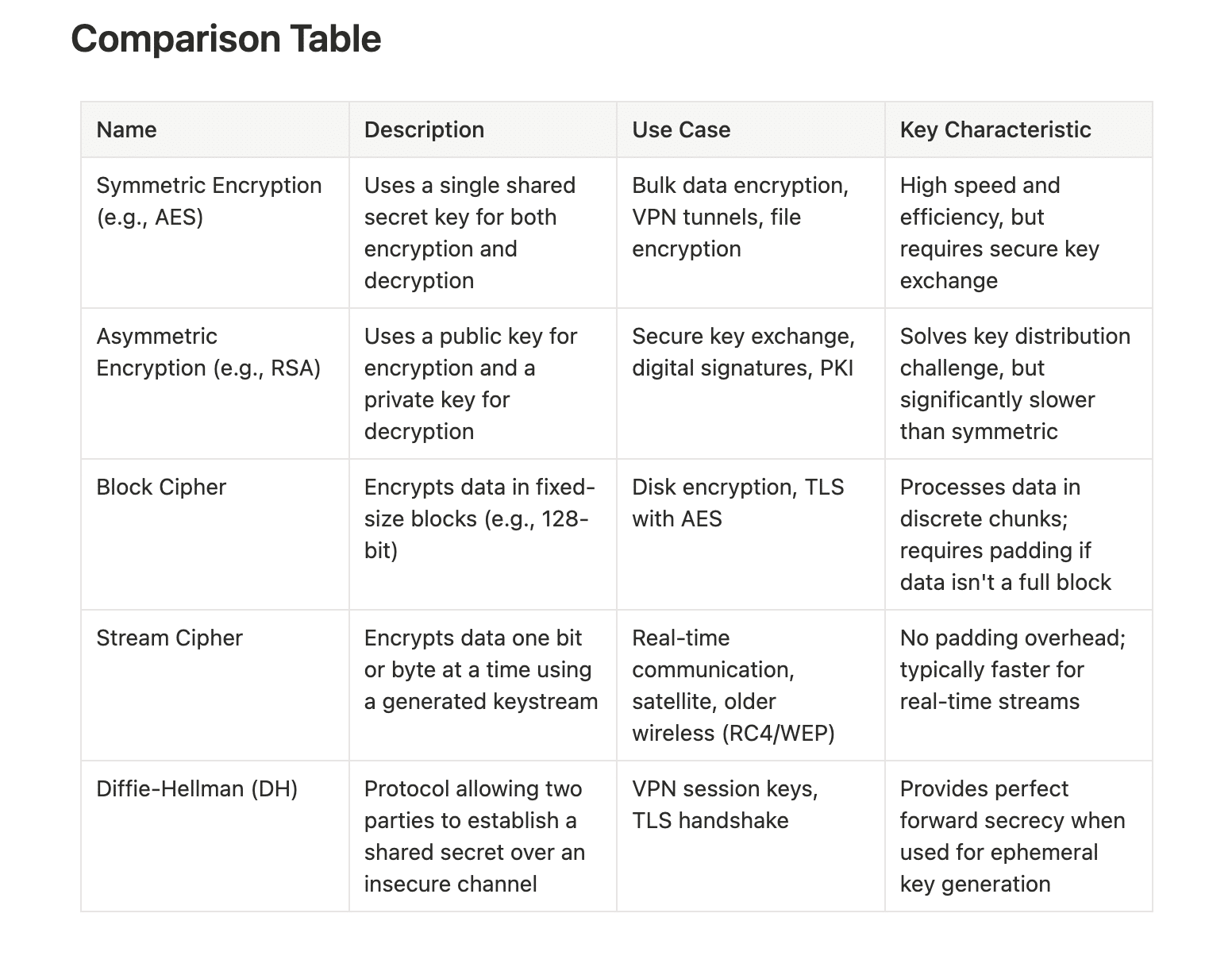
- Block cipher — processes data in fixed-size chunks (e.g., 128 bits), encrypting one block at a time.
- Stream cipher — encrypts plaintext one bit or byte at a time, continuously combining the plaintext with a generated keystream.
💡 Real-world Example: AES is a prominent block cipher, widely used for encrypting hard drives and secure communications. RC4, while less secure for new applications, was historically used as a stream cipher in protocols like WEP.
Symmetric Encryption Algorithms
Symmetric encryption uses a single, shared secret key for both encrypting and decrypting data. It is highly efficient and fast, making it ideal for encrypting large volumes of data. However, the secure distribution of this shared key is a significant challenge, often requiring an asymmetric encryption process to solve.
💡 Real-world Example: When you establish a VPN tunnel, after the initial secure key exchange, the bulk of the data transfer is encrypted using a symmetric algorithm like AES-256 for optimal performance.
Asymmetric Encryption Algorithms (Public Key Cryptography)
Asymmetric encryption uses a pair of mathematically linked keys: a public key and a private key. Data encrypted with one key can only be decrypted by its corresponding pair. The public key can be freely distributed while the private key must remain secret. This elegantly solves the key distribution problem, though it is significantly slower than symmetric encryption.
💡 Real-world Example: When you visit an HTTPS website, your browser uses the website’s public key (from its digital certificate) to encrypt a session key. The web server then uses its private key to decrypt this session key, establishing a secure symmetric communication channel.
Public Key Infrastructure (PKI) and Digital Certificates
PKI is a framework of policies, procedures, and systems that manage digital certificates and public-key encryption. A Certificate Authority (CA) issues digital certificates, which bind a public key to an identity. These certificates provide authenticity, verifying the ownership of a public key and establishing trust in online interactions.
💡 Real-world Example: Every time your browser verifies a website’s identity, it relies on PKI. The website presents its digital certificate, which your browser trusts because it was issued by a recognized CA whose root certificate is pre-installed in your operating system’s trust store.
Real World Analogy
🔑 Imagine PKI as a global passport system for digital identities. A Certificate Authority acts like a trusted government passport office that verifies your identity and issues you a digital passport (your certificate) containing your public key. When you interact with a server, they verify your passport’s authenticity by checking it was issued by a recognized authority — just like border control checks your passport. This allows both parties to trust each other’s identities and securely exchange information.
Chapter Recap
This chapter provided a foundational understanding of cryptography, highlighting its critical role in ensuring data confidentiality, integrity, authentication, and non-repudiation. We explored the core distinction between symmetric and asymmetric encryption: symmetric for efficient bulk data encryption (AES) and asymmetric for secure key exchange and digital signatures (RSA, Diffie-Hellman).
We also delved into PKI, emphasizing the role of Certificate Authorities in issuing and managing digital certificates essential for establishing trust. The hybrid encryption model — leveraging the strengths of both symmetric and asymmetric methods — represents the practical application of these concepts in real-world protocols like TLS.
Key Exam Points
- Asymmetric encryption is significantly more CPU-intensive and slower than symmetric — symmetric is preferred for bulk data encryption.
- For symmetric algorithms, AES-128 is the minimum recommended; AES-256 offers stronger protection. AES has replaced 3DES as the current standard.
- Diffie-Hellman is used for secure key exchange to establish a shared secret over an insecure channel, not for data encryption itself. It provides Perfect Forward Secrecy (PFS).
- RSA is used for both secure key exchange and digital signatures, typically encrypting only the symmetric session key.
- Block ciphers (AES) operate on fixed-size blocks; stream ciphers (RC4) operate on individual bits/bytes.
- Cryptography provides four services: Confidentiality (encryption), Integrity (hashing), Authentication (digital signatures/PKI), and Non-repudiation (digital signatures).
- PKI components: Certificate Authorities (CAs), Root CAs, Subordinate CAs, and Certificate Revocation Lists (CRLs).
- Digital certificates primarily conform to the X.509 standard.
- A One-Time Pad is theoretically unbreakable if keys are truly random, used only once, and equal in length to the plaintext.
Common Mistakes to Avoid
⚠️ Symmetric is not weaker than asymmetric — AES-256 is extremely strong. The challenge is key distribution, which asymmetric methods solve — not that symmetric is insecure.
⚠️ RSA is not for bulk data — Asymmetric encryption is too slow for large amounts of data. Its primary use is exchanging small amounts of data (like session keys) or digital signatures.
⚠️ One-Time Pad ≠ One-Time Password — A cryptographic One-Time Pad is an unbreakable encryption scheme where a random key is used once and matches the message length. One-Time Passwords are an authentication mechanism — completely different concept.
⚠️ PKI hierarchy matters — A compromised Root CA or poorly managed Subordinate CA undermines the entire trust model, allowing attackers to issue fraudulent certificates and impersonate legitimate entities.
⚠️ Stronger encryption ≠ automatic security — Security also depends on key management, protocol implementation, and prevention of side-channel attacks. A weak implementation with a strong algorithm can still be vulnerable.